
What’s Really Hiding Behind Outbursts, Irritation, and Emotional Withdrawal?
*The hidden side of ‘I must be strong’ is this: you’re always giving, but never asking or receiving. That’s what it ultimately means, doesn’t it?
The masculine experience of ‘be strong’ often becomes the belief that you must be self-sufficient—that you should never need help, never ask for support, and never receive it.
How realistic and sustainable does that sound?*
– The Rise of the Phoenix Man
There are moments when anger appears as an explosive outburst—sudden, intense, and difficult to control. Other times, it is less obvious but equally present: a constant irritation, tension that never seems to disappear, short responses, emotional distance, or prolonged silence.
For many men, anger is one of the few emotions they feel allowed to express without fearing that they will lose control, respect, or their sense of masculinity.
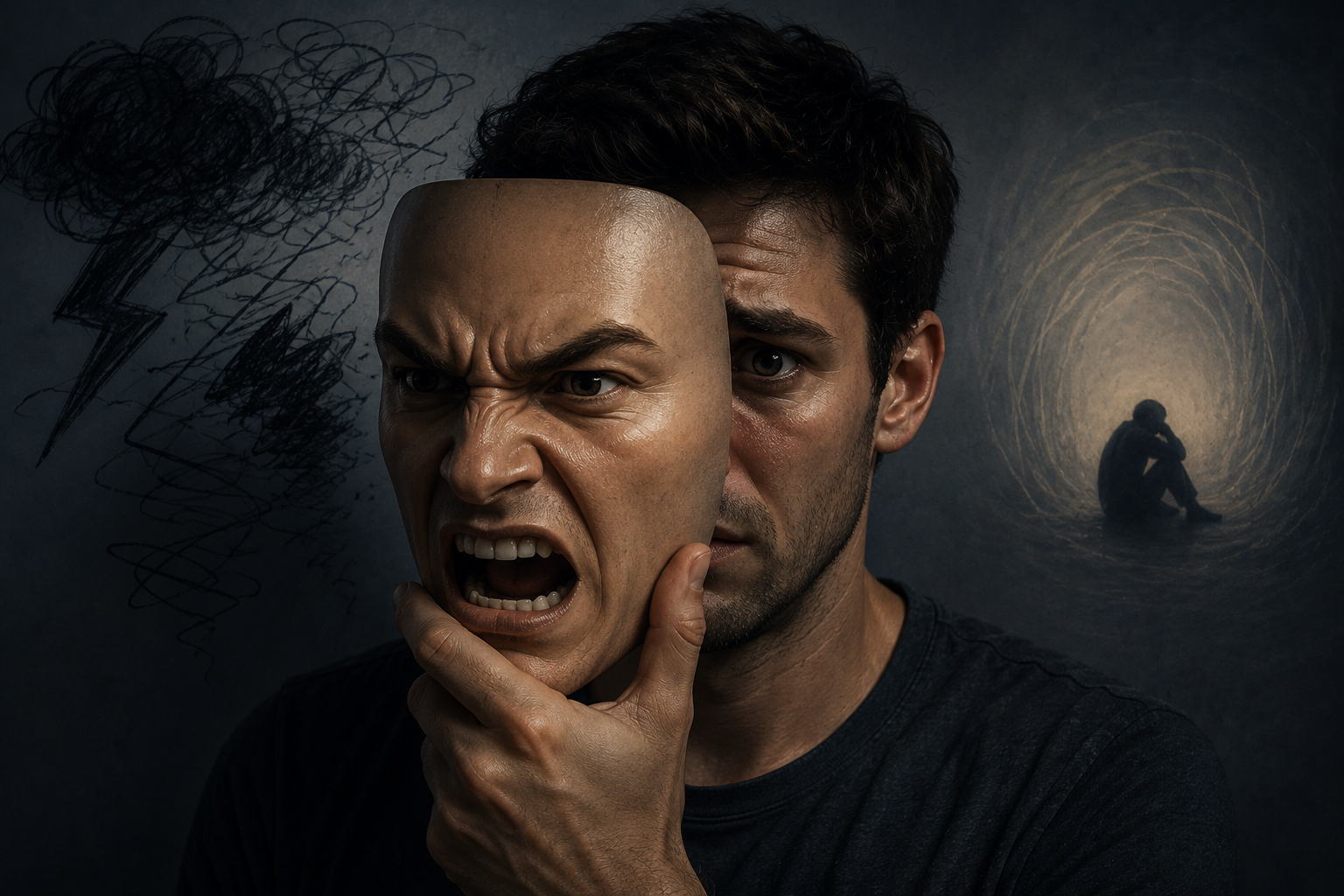
Yet most of the time, anger is not the primary emotion. It is a mask. A protective layer covering something much more vulnerable underneath.
Why Anger Often Becomes the “Acceptable” Emotion
Modern psychology suggests that anger frequently functions as a defensive emotion. It emerges when the mind is trying to protect itself from emotions that feel more difficult, painful, or threatening to experience directly.
Emotions such as:
- Sadness.
- Fear.
- Shame.
- Rejection.
- Helplessness.
- Disappointment.
Rather than feeling these emotions fully, the nervous system often shifts into anger because anger feels safer. Many boys grow up receiving messages such as:
- “Don’t cry.”
- “Be tough.”
- “Man up.”
- “Stop being so sensitive.”
Over time, they learn that certain emotions are acceptable while others are not. Sadness becomes weakness. Fear becomes failure. Vulnerability becomes danger.
But anger often remains permitted – even encouraged.
As a result, many men develop a limited emotional vocabulary. They may feel a wide range of emotions internally, but anger becomes the only language they know how to speak.
What Is Really Hiding Beneath Anger?
If we pause and look beyond the reaction itself, anger often turns out to be only the visible tip of a much larger emotional iceberg.
1. Hurt and Sadness
Many men react with irritation when they are actually hurt. They may feel rejected, disappointed, ignored, or unseen, but struggle to identify or express those feelings directly.
Instead of saying:
“That hurt me.” They say: “You never respect me.”
The anger is visible. The pain remains hidden.
2. Fear
Fear is one of the most common emotions hidden beneath anger.
- Fear of failure.
- Fear of rejection.
- Fear of abandonment.
- Fear of not being enough.
When these fears are activated, anger often emerges as a protective response.
Instead of saying: “I’m afraid I’m disappointing you.”, a man may respond with: “Just leave me alone.”
The reaction creates distance, even though the underlying emotion is often a desire for connection.
3. Shame
Shame is one of the most uncomfortable emotions human beings experience.
It carries the message: “There is something wrong with me.”
Because shame feels so painful, many people defend against it unconsciously. Sometimes that defense looks like criticism, blame or even anger.
A man who feels inadequate may become defensive when receiving feedback, not because the feedback itself is unbearable, but because it touches a deeper wound.
4. Helplessness
Few emotions feel more uncomfortable than powerlessness. When a situation feels overwhelming and there seems to be no solution, anger can create the illusion of control:
- Raising one’s voice.
- Becoming argumentative.
- Trying to dominate the conversation.
These reactions often mask a much deeper truth: “I don’t know what to do with what I’m feeling.”
How This Pattern Affects Relationships
In relationships, anger as a mask often creates confusion for both partners. The partner sees the surface behavior:
- The irritability.
- The withdrawal.
- The defensiveness.
- The emotional distance.
Without seeing what lies underneath, these reactions can easily be interpreted as indifference, selfishness, or lack of love.
Meanwhile, the man experiencing these emotions may feel misunderstood.
He may genuinely care deeply, yet struggle to communicate what is happening inside him. This creates a painful cycle: one partner reacts with anger or silence while the other feels hurt, rejected, or disconnected.
This builds a relationship where connection is desired by both partners, yet neither feels understood.
What Happens When Emotions Stay Hidden
Emotions do not disappear simply because they are ignored. They remain within the body and mind. Over time, suppressed emotions can manifest as:
- Chronic irritability
- Emotional numbness
- Increased stress
- Relationship difficulties
- Anxiety
- Burnout
- Unexpected emotional outbursts
Many men eventually describe feeling disconnected from themselves. Not because they do not have emotions, but because they have lost access to them.
It is like trying to navigate life with only one emotional tool available. Every situation gets translated into anger, regardless of what is actually being felt.
Learning to Look Beyond the Mask
The goal is not to eliminate anger. Anger itself is not the problem. In fact, anger often carries important information.
It signals that something feels unfair, painful, threatening, or unresolved. The challenge is learning to ask: “What is underneath this anger?”
The next time you notice yourself feeling angry, pause for a moment and explore further. Could there also be:
- Disappointment?
- Fear?
- Embarrassment?
- Shame?
- Hurt?
- Helplessness?
Learning to identify these deeper emotions is a crucial step toward emotional intelligence and emotional maturity.
Instead of saying: “You made me angry.”
Try asking yourself: “What happened here that hurt me?”
That single question can reveal far more than the anger itself ever could.
A Message for Women
If the man in your life frequently expresses anger or seems emotionally distant, there may be a deeper story beneath that behavior. This does not mean you should tolerate hurtful behavior or ignore your own boundaries.
Healthy boundaries are essential.
However, understanding that anger is sometimes a learned form of protection can create a different perspective.
- Sometimes what appears as indifference is actually fear.
- Sometimes what appears as withdrawal is uncertainty.
- Sometimes what appears as anger is unexpressed pain.
A safe environment can help emotional openness develop, but it is important to remember that vulnerability cannot be forced. It can only be invited. The decision to open up must ultimately come from within.
Final Thoughts
Anger is rarely the whole story.
More often, it is a messenger carrying emotions that have not yet found words. Beneath anger there is often a quieter voice saying:
- “I’m hurt.”
- “I’m afraid.”
- “I feel alone.”
- “I need connection.”
When a man learns to recognize these emotions and express them openly, he does not become weaker. He becomes more self-aware, more emotionally intelligent, more connected to himself and the people he loves.
And perhaps that is one of the most powerful forms of strength a man can develop—not the ability to hide what he feels, but the courage to understand it.